
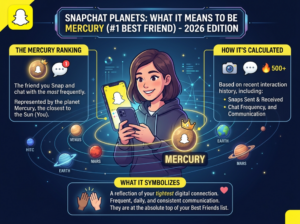
Being someone’s Mercury on Snapchat isn’t just a ranking. It’s a statement. Out of every single person on their friends list, potentially hundreds of contacts, you are the one they interact with the most. No one else comes close.
Mercury is the first planet in the Snapchat Friend Solar System and represents your #1 best friend based on interaction frequency. If you’ve ever tapped a gold badge on a friend’s profile and seen a small red planet surrounded by glowing hearts, you’ve found your answer: you’re their closest connection on the entire app.
But what exactly does “Mercury” mean? How does Snapchat decide who earns it? And can you actually lose it overnight?
This guide breaks down everything about the Mercury Snapchat Planet, from its visual design to the real strategies that keep you in the closest orbit. Being at the very center of the Snapchat Planets means you are someone’s #1 Best Friend.
What Does Mercury Mean on Snapchat?
In the Snapchat Friend Solar System, you sit at the center as the Sun. Your top eight friends orbit around you as planets, ranked from Mercury (closest) to Neptune (farthest). The ranking is based entirely on how often you interact with each person through snaps, chats, story replies, calls, and other engagement signals.
Mercury = Position #1. The friend who gets this planet is the person you exchange the most snaps with, chat with the most frequently, and engage with the most consistently. They’re your digital ride-or-die.
Here’s the quick breakdown:
| Detail | Mercury |
|---|---|
| Position | #1 Best Friend |
| What it means | Highest interaction on Snapchat |
| Planet color | Bright red |
| Emoji elements | 4 red hearts, twinkling stars |
| Bitmoji placement | Sitting on top of the planet |
| Subscription required | Yes, Snapchat+ only |
Mercury isn’t a badge you apply manually. Snapchat’s algorithm assigns it automatically based on your real activity. You can’t pick your Mercury, and you can’t force someone to make you theirs. It’s earned through consistent, genuine interaction.
What Does the Mercury Planet Look Like on Snapchat?
Spotting Mercury is easy once you know what to look for. It has the most visually striking design of all eight Snapchat planets, and that’s intentional. The #1 position should stand out.
Visual elements:
- Planet color: A bold, bright red, impossible to confuse with any other planet in the solar system
- Hearts: Four distinct red hearts floating around the planet, signaling deep emotional connection
- Stars: Small twinkling stars scattered in the background, adding warmth
- Bitmoji: Your friend’s Bitmoji sits directly on top of the planet, front and center
- Overall feel: Warm, vibrant, unmistakably “closest friend” energy
Compare this to Neptune, a cold, deep blue planet with no hearts and a tiny, distant Bitmoji. The visual contrast between Mercury and the outer planets is night and day. Snapchat designed these differences deliberately so you can read the ranking at a glance without needing to check any text.
f your streak drops, you might be pushed out to the second position, Venus on Snapchat planets.
How Does Snapchat Decide Who Gets Mercury?
Snapchat hasn’t published the exact formula. But based on community testing and observable patterns, several interaction signals clearly feed into the algorithm:
Snap Frequency (Heaviest Weight)
The number of snaps you send and receive with someone is the strongest ranking factor. Daily snapping, even quick, low-effort snaps, builds interaction volume faster than anything else. The friend you exchange the most snaps with almost always holds Mercury.
Chat Activity
Regular back-and-forth chatting matters more than most people realize. Long conversations carry more weight than one-word replies. If two friends have similar snap counts, the one with deeper chat engagement tends to edge ahead.
Snap Streaks
A long-running Snapstreak signals consistent daily interaction. Mercury holders often share streaks above 150-200 days. The streak itself doesn’t guarantee the #1 spot, but it reinforces the other signals the algorithm is already tracking.
Story Replies and Reactions
Simply viewing someone’s story doesn’t move the needle much. Replying to a story, even with a quick emoji, registers as direct interaction and contributes to your closeness score.
Voice and Video Calls
Calls add a weighted signal that most users ignore. Friends who call each other through Snapchat, even briefly, tend to hold stronger positions than friends who only text and snap.
Reply Speed
Responding quickly signals active engagement. Consistently fast replies tell the algorithm this friendship is alive and prioritized. Leaving someone on read for hours doesn’t help.
How to Become Someone’s Mercury on Snapchat
You can’t guarantee the Mercury position. But you can dramatically increase your chances by doing what the algorithm rewards: consistent, varied, one-on-one interaction.
Here’s a practical daily checklist:
- Send 3-5 private snaps per day. Not group snaps, private. Group snaps carry almost no weight toward individual rankings.
- Have at least one real conversation. A genuine back-and-forth chat, not just “streaks.” The algorithm appears to distinguish between meaningful exchanges and single-word messages.
- Reply to their stories. Don’t just watch. Tap that reply button. Even a fire emoji counts as an interaction.
- Maintain your streak. Don’t let the hourglass timer run out. Streak breaks cause ranking drops within 48 hours.
- Call them occasionally. Even a 60-second voice call adds an engagement signal most competitors for Mercury aren’t providing.
- Reply fast. When they snap you, respond within minutes rather than hours.
The key principle: Consistency beats intensity. Snapping someone 50 times in one day and then going quiet for a week will never beat someone who sends 5 snaps daily for a month straight. The algorithm rewards patterns, not bursts. Dropping to third place means you will see Earth on Snapchat planets instead of the pinkish-red orb.
What Keeps You at Mercury, And What Makes You Drop
Earning mercury is one thing. Keeping it is another.
What Keeps You There
- Daily snap exchanges without gaps
- An active, unbroken Snapstreak (especially 100+ days)
- Regular chatting beyond just streak maintenance
- Fast reply times on both sides
- Occasional voice or video calls
Some users notice their rank fluctuate rapidly between the first spot and the fourth spot, Mars on Snapchat planets.
What Causes a Drop
- Going quiet for even a few days. The algorithm recalculates roughly every 24-72 hours. A short silence creates an opening for someone else to take the #1 spot.
- Breaking a long streak. This is one of the fastest ways to drop. A broken 200-day streak can push you down 2-3 positions within 48 hours.
- Your friend increasing activity with someone else. Rankings are relative. Even if your interaction stays the same, someone else snapping them more frequently can push you out of Mercury.
- Only sending streak snaps. If your entire interaction is a daily black screen with an “S” on it, that’s thin engagement. Someone else having actual conversations will overtake you.
To avoid dropping as far back as Jupiter on Snapchat planets, make sure to snap this person daily.
Mercury vs. Venus, What’s the Real Difference?
On paper, the gap between Mercury and Venus looks small. One position. But in practice, the difference is meaningful.
| Factor | Mercury (#1) | Venus (#2) |
|---|---|---|
| Interaction level | Highest on the platform | Very high, but slightly less |
| Typical streak length | 150+ days | 100+ days |
| Chat depth | Frequent, long conversations | Regular but slightly shorter |
| Visual design | Red planet, red hearts | Beige planet, multicolor hearts |
| Emotional significance | “You’re my person.” | “You’re incredibly close.” |
Here’s what’s interesting: Mercury is often built on volume. Venus friendships sometimes involve deeper, more emotionally substantive conversations; they just happen slightly less often.
Being someone’s Venus doesn’t mean you’re less important to them. It means someone else is simply more active on the app.
Can Mercury Be One-Sided?
Absolutely. And this catches people off guard constantly.
You can be someone’s Mercury without them being yours. The system calculates each person’s solar system independently. If your friend snaps you more than anyone else, you’re their Mercury. But if you snap three other people more frequently than them, they might be your Mars or Jupiter.
This one-sided dynamic is actually common. It doesn’t mean the friendship is unbalanced in real life; it just means one person’s Snapchat activity is distributed differently.
The Best Friends badge (gold ring) tells you whether the connection is mutual. If you see “Best Friends” on their profile, you’re both in each other’s top eight. If you see “Friends,” you’re in their top eight, but you’re not in yours.
The Emotional Weight of Being Mercury
Let’s be honest about what Mercury really triggers: validation.
Being someone’s #1, seeing that bright red planet with the hearts, feels genuinely good. It confirms what you hoped: this person talks to you more than anyone else. In a world where social connections are increasingly ambiguous, Mercury provides certainty.
But that emotional clarity cuts both ways. Discovering you’re not someone’s Mercury, especially a person you consider your best friend, can sting. It’s one thing to suspect your friend talks to other people more. It’s another thing to see a planet confirming it.
Snapchat built this feature, understanding exactly how it would feel. The dopamine hit of being #1 keeps you opening the app. The anxiety of potentially losing it keeps you snapping. It’s gamification in its purest form.
If checking your planet ranking is starting to affect how you feel about a friendship, remember what Mercury actually measures: app activity. Not loyalty. Not history. Not love. Just how often you tap a screen. The friend you’ve known for ten years who never uses Snapchat will always rank below the classmate you streak with daily. That doesn’t make the streak more meaningful.
Common Myths About Mercury
Myth: You can manually choose your Mercury. False. Snapchat assigns planets automatically based on interaction data. There’s no setting to designate someone as your #1.
Myth: Streaks alone guarantee Mercury. False. A streak helps, but it’s one of several factors. Someone with no streak but heavy daily chatting and calling can outrank a streak-only connection.
Myth: Your Mercury can see that they’re your Mercury. Not directly. They can only see which planet they are in your system by tapping the badge on your profile. They’d need Snapchat+ to do that.
Myth: Mercury never changes. It changes all the time. Rankings recalculate every 24-72 hours. A Mercury position is earned daily, not permanently.
Frequently Asked Questions
What does Mercury mean on Snapchat Planets?
Mercury represents your #1 best friend on Snapchat. It’s the closest planet to the Sun in the Friend Solar System and is assigned to the friend you interact with the most through snaps, chats, calls, and story replies.
What color is Mercury on Snapchat?
Mercury appears as a bright red planet surrounded by four red hearts, twinkling stars, and your friend’s Bitmoji sitting on top.
How do I become someone’s Mercury on Snapchat?
Send daily private snaps, chat regularly, maintain your Snapstreak, reply to their stories, and respond quickly to their messages. Consistency matters more than volume.
Can your Mercury change on Snapchat?
Yes. Rankings recalculate every 24-72 hours. If someone else increases their interactions with your friend while yours decrease, they can take the Mercury position.
Is Mercury mutual on Snapchat?
Not necessarily. You can be someone’s Mercury without them being yours. Each person’s solar system is calculated independently based on their own interaction data.
What’s the difference between Mercury and Venus on Snapchat?
Mercury is your #1 friend (highest interaction). Venus is #2. Mercury’s design features red hearts on a red planet, while Venus has multicolored hearts on a beige planet. The interaction gap between them is usually small but measurable.
Can I be Mercury without a Snapstreak?
Yes, streaks contribute to rankings, but they’re not required. Heavy chatting, calling, and story engagement can push you to Mercury even without an active streak.
Does Mercury mean they’re my best friend in real life?
Not necessarily. Mercury measures Snapchat activity, not real-life closeness. A friend you see every day but never snap with will rank lower than someone you only interact with through the app.